Implant vs Dentures

Implant vs Dentures

Implant vs Dentures in Marlton NJ

Stability Implants stay fixed in place

Dentures can shift or move, while implants are secured and function more like natural teeth.

Comfort Dentures may feel bulkier

Many patients find implants feel more natural when chewing, speaking, and smiling.

Jawbone Health Implants help preserve bone

Because implants stimulate the jawbone, they can help reduce the bone loss that often follows tooth loss.

Investment Dentures usually cost less upfront

Implants typically require a higher initial investment but may offer greater long-term value.

Side-by-Side Comparison

This chart gives patients a simple way to understand the biggest differences between traditional dentures and dental implants.

Comparison of dentures and dental implants
Feature Dentures Dental Implants
Fit Rest on the gums and may loosen over time. Anchored in the jawbone for a secure fit.
Daily Wear Typically removed for cleaning and sleeping. Cleaned much like natural teeth.
Chewing Can limit chewing force and food choices. Usually offers stronger biting and chewing ability.
Speech May affect speech if the fit changes. Often feels more natural when speaking.
Bone Support Does not prevent jawbone shrinkage. Helps support the jawbone after tooth loss.
Timeline Usually faster to complete. Usually takes longer because healing is involved.
Upfront Cost Lower initial cost. Higher initial cost.
Long-Term Value May need relines, adjustments, or replacement over time. Designed as a long-term replacement option.

Three Common Treatment Paths

Patients are not always choosing between only two extremes. In many cases, implant-supported dentures provide a middle-ground option.

Traditional Dentures

Removable replacement teeth

Traditional dentures sit over the gums and can replace a full arch of missing teeth.

  • Lower upfront cost
  • No implant surgery required
  • Usually faster treatment timeline
  • Can move, rub, or loosen over time
Dental Implants

Fixed support in the jawbone

Implants replace the tooth root and support crowns, bridges, or full-arch restorations.

  • Secure and stable
  • Often feels more natural
  • Helps support bone levels
  • Higher initial investment
Implant-Supported Dentures

More stability without a full fixed bridge

This option uses implants to hold a denture more securely than a traditional removable appliance.

  • Improved retention
  • Less movement during eating and speaking
  • Often more affordable than a fully fixed implant bridge
  • Can be a strong middle-ground option

Who Might Prefer Dentures?

Dentures may still be the right option for some patients depending on health, timeline, anatomy, or budget.

  • You want a lower upfront cost.
  • You prefer to avoid implant surgery.
  • You need a solution completed more quickly.
  • You are looking for a removable option.
  • You are not currently a candidate for implant treatment without additional procedures.

Who Might Prefer Implants?

Implants are often preferred by patients who want a more secure, long-term solution and are looking for stronger function.

  • You want a stable solution that does not slip.
  • You want to eat with more confidence.
  • You want a result that feels closer to natural teeth.
  • You are concerned about long-term jawbone changes.
  • You are looking for a long-term investment in your smile and oral health.
Before and after implant-supported smile restoration
Why Many Patients Choose Implants 1 More secure fit Implants do not rely on suction or adhesives the same way traditional dentures do. 2 Better chewing confidence A stable foundation often allows patients to enjoy a wider range of foods. 3 Long-term support Implants can help support the jawbone after tooth loss and reduce future instability.

Frequently Asked Questions

These are common questions patients ask when deciding between dentures and implant treatment.

Are implants better than dentures?

Implants are often considered the more stable and long-term option, but the right choice depends on anatomy, goals, budget, and overall oral health.

Do dentures cost less?

Traditional dentures usually have a lower upfront cost. However, long-term maintenance, relines, and replacement needs may affect overall value over time.

Can I get implants if I already wear dentures?

In many cases, yes. Some patients move from traditional dentures to implant-supported dentures or fixed implant restorations after evaluation.

What if I am not ready for full implants?

Implant-supported dentures may be a strong middle-ground option for patients who want better retention without a fully fixed bridge.
Implant vs Dentures

Implant vs Bridge

Implant vs Bridge in Marlton NJ

Single Tooth Replacement Options

Dental Bridge vs. Dental Implant

If you are missing one tooth or several teeth in a row, two of the most common treatment options are a dental bridge and a dental implant. Both can restore appearance and function, but they work very differently. Understanding how each option affects neighboring teeth, long-term maintenance, comfort, and bone support can help you choose the right solution.

Tooth Support Bridges rely on adjacent teeth

A traditional bridge is supported by the teeth next to the missing space, which usually need to be prepared.

Bone Health Implants support the jawbone

Because the implant is placed in the bone, it can help reduce the shrinkage that often happens after tooth loss.

Timeline Bridges are often faster

Bridges can usually be completed more quickly, while implants often require healing time before the final tooth is placed.

Long-Term Approach Implants stand on their own

Implants replace the missing tooth without depending on neighboring teeth for support.

Side-by-Side Comparison

This chart gives patients a clear overview of the biggest differences between a dental bridge and a dental implant.

Comparison of dental bridges and dental implants
Feature Dental Bridge Dental Implant
How it works Uses neighboring teeth to support a replacement tooth. Uses an implant placed in the jawbone to support the replacement tooth.
Effect on adjacent teeth Usually requires shaping the teeth next to the gap. Usually does not require altering the adjacent teeth.
Bone support Does not replace the missing tooth root in the bone. Replaces the missing root and helps support the bone.
Cleaning Requires special cleaning underneath the bridge. Typically cleaned more like a natural tooth.
Timeline Usually faster to complete. Usually takes longer because the implant must heal.
Surgery No implant surgery required. Requires implant placement.
Upfront cost Often lower upfront cost. Often higher upfront cost.
Long-term value May need replacement and depends on support teeth. Designed as a long-term standalone replacement option.

Two Common Treatment Paths

Both bridges and implants can restore a missing tooth. The best option often depends on the health of the neighboring teeth, bone levels, budget, and long-term goals.

Dental Bridge

A fixed option supported by nearby teeth

A bridge can fill the gap left by a missing tooth by attaching to crowns placed on the teeth next to the space.

  • Usually faster treatment
  • No implant surgery
  • May cost less upfront
  • Often requires altering healthy adjacent teeth
Dental Implant

A standalone replacement tooth

An implant replaces the missing tooth root and supports a crown without relying on neighboring teeth.

  • Does not depend on adjacent teeth
  • Helps support jawbone levels
  • Often easier to clean like a natural tooth
  • Requires implant placement and healing time

Who Might Prefer a Bridge?

A bridge may be the right fit for some patients depending on timing, anatomy, and treatment preferences.

  • You want to avoid implant surgery.
  • You want a treatment completed more quickly.
  • The adjacent teeth already need crowns.
  • You are looking for a lower upfront investment.
  • You are not currently a candidate for implant placement without additional procedures.

Who Might Prefer an Implant?

Implants are often preferred by patients who want to replace the missing tooth without involving the neighboring teeth.

  • You want a standalone replacement option.
  • You want to preserve the natural structure of adjacent teeth.
  • You want a long-term solution that supports the bone.
  • You want a restoration that often feels closer to a natural tooth.
  • You are comfortable with a longer treatment timeline.
Before and after replacement of a missing tooth with a dental implant or bridge
Why Many Patients Choose Implants 1 No reliance on neighboring teeth An implant can replace a tooth without preparing healthy adjacent teeth for support. 2 Helps support bone levels Because the implant is placed in the jawbone, it replaces the root structure of the missing tooth. 3 Long-term standalone solution Many patients like the idea of replacing the missing tooth without tying the result to the health of support teeth.

Frequently Asked Questions

These are common questions patients ask when deciding between a dental bridge and a dental implant.

Is an implant better than a bridge?

In many cases, implants offer long-term advantages because they do not rely on adjacent teeth and can help support the bone. The right choice depends on your health, anatomy, and goals.

Is a bridge faster than an implant?

Yes, a bridge is often completed more quickly because it does not require implant healing time.

Do implants last longer than bridges?

Implants are often viewed as a long-term solution, but lifespan depends on oral hygiene, bite forces, health factors, and regular dental care.

Can I get an implant if I have been missing the tooth for a while?

Possibly. A consultation and imaging can help determine whether you have enough bone support or whether additional treatment may be needed.

Same Day Dental Implants

Same Day Dental Implants in Marlton NJ

Speed Teeth in one visit

Same-day implants allow you to receive a temporary tooth or full smile on the same day as placement.

Convenience Fewer appointments

This streamlined approach reduces the number of visits compared to traditional implant timelines.

Function Immediate confidence

Patients can often eat, speak, and smile more comfortably right after the procedure.

Healing Still requires integration

Even with same-day teeth, implants still need time to fully fuse with the jawbone.

Same-Day Implants vs Traditional Implants

Both options use dental implants, but the timeline and experience can be very different.

Feature Traditional Implants Same-Day Implants
Timeline Several months from start to finish. Temporary teeth placed the same day.
Appearance Gap or temporary solution during healing. Immediate visible smile.
Appointments Multiple visits over time. Fewer visits overall.
Healing Healing before final crown placement. Healing occurs with temporary tooth in place.
Function Delayed full function. Earlier return to chewing and speaking.
Eligibility Most patients qualify. Requires good bone and stability.
Upfront Cost Standard implant cost. May be similar or slightly higher.
Long-Term Result Permanent restoration after healing. Temporary first, then final restoration.

How Same-Day Dental Implants Work

This treatment is designed to replace missing teeth quickly while still following a structured implant process.

Step 1

Digital Planning

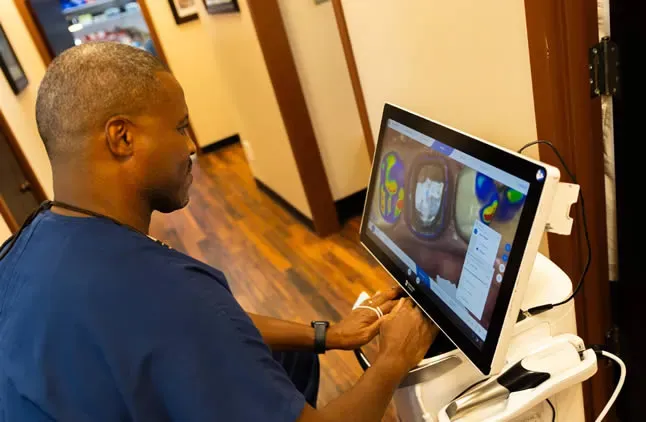
We use advanced imaging and 3D scans to plan precise implant placement.

  • Detailed evaluation
  • Bone and gum assessment
  • Customized treatment plan
Step 2

Implant Placement

The implant is placed into the jawbone, often with tooth extraction if needed.

  • Performed under anesthesia
  • Minimally invasive approach
  • Stable foundation created
Step 3

Same-Day Teeth

A temporary crown or bridge is attached the same day for immediate function.

  • Walk out with a smile
  • No visible gaps
  • Final restoration later

Who Might Be a Candidate?

Same-day implants are not for everyone, but many patients may qualify after evaluation.

  • You have good overall oral health.
  • You have sufficient jawbone support.
  • You want to avoid waiting months for teeth.
  • You want fewer dental visits.
  • You are looking for immediate cosmetic improvement.

Who Might Need a Traditional Approach?

Some patients may benefit more from a staged implant process depending on their condition.

  • You have limited bone density.
  • You need bone grafting.
  • You have active gum disease.
  • You need more complex reconstruction.
  • You prefer a slower, staged treatment plan.

Frequently Asked Questions

Common questions about same-day dental implants.

What are same-day dental implants?

They are implants that receive a temporary tooth on the same day they are placed, allowing immediate appearance and function.

Are same-day implants permanent?

The implant is permanent, but the initial tooth is temporary and later replaced with a final restoration.

Are same-day implants safe?

Yes, when performed on the right candidate with proper planning and technique.

How long does the procedure take?

It can take a few hours depending on the number of implants placed.

Immediate Load Dental Implants

Immediate Load Dental Implants

Immediate Load Dental Implants in Marlton NJ

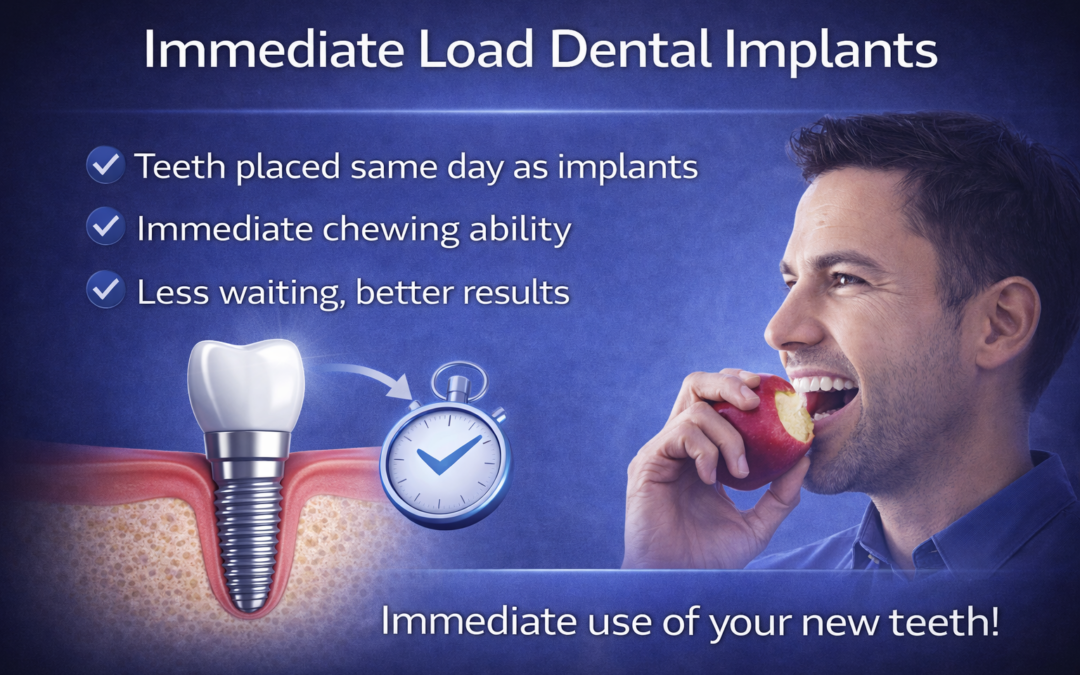
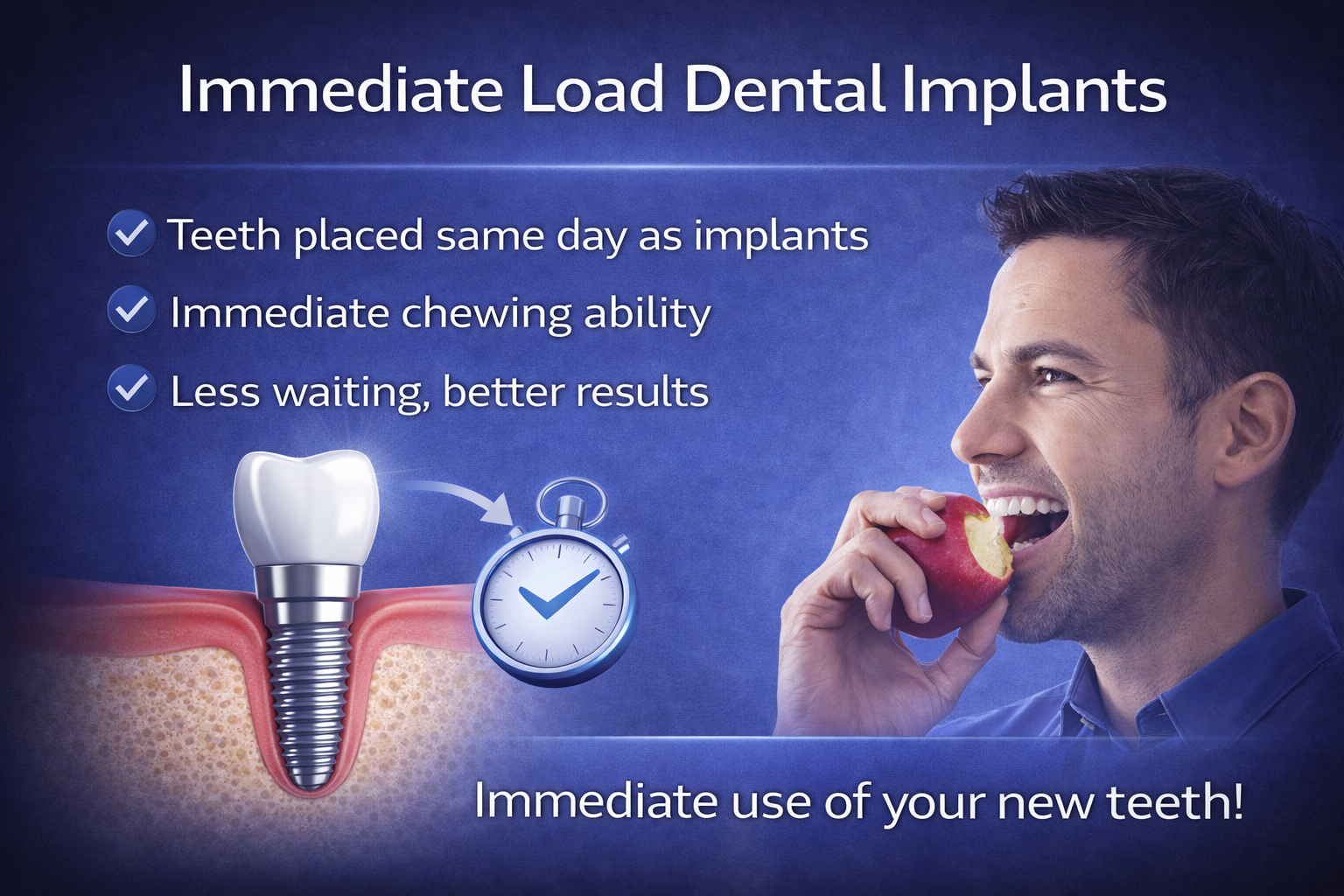
Immediate load dental implants allow patients to receive replacement teeth on the same day or shortly after implant placement. This advanced technique eliminates the traditional waiting period and provides faster restoration of your smile.

Unlike conventional implants that require several months of healing before teeth are placed, immediate load implants enable a temporary restoration to be attached right away.

As part of comprehensive Dental Implants treatment, immediate load implants offer a faster and more convenient solution for replacing missing teeth.

loadImplan

What Are Immediate Load Dental Implants?

Immediate load dental implants are implants that support a temporary crown, bridge, or denture immediately after placement.

This means patients can leave the dental office with functional teeth the same day.

Traditional implants require a healing period known as osseointegration before attaching the final restoration. Immediate load implants reduce or eliminate this waiting period.

This approach is sometimes referred to as:

  • Same day implants

  • Teeth in a day

  • Same day teeth

Patients may also explore Same Day Dental Implants for similar fast-results solutions.

How Immediate Load Implants Work

Immediate load implants rely on strong initial implant stability at the time of placement.

The process involves:

  • Placing implants in areas with sufficient bone density

  • Attaching a temporary restoration immediately

  • Allowing the implant to integrate with the bone over time

Once healing is complete, the temporary restoration is replaced with a permanent crown, bridge, or denture.

Patients with insufficient bone may require Bone Grafting for Dental Implants before qualifying for this treatment.

Benefits of Immediate Load Dental Implants

Immediate load implants provide several advantages for patients seeking fast tooth replacement.

Faster Results

Patients receive teeth immediately instead of waiting months.

Improved Appearance

You can leave the office with a complete smile the same day.

Fewer Appointments

The treatment process is streamlined, reducing the number of visits.

Maintains Function

Patients can speak and eat more comfortably right away.

Preserves Jawbone

Like traditional implants, immediate load implants help prevent bone loss.

Immediate Load vs Traditional Dental Implants

The main difference between immediate load and traditional implants is timing.

Traditional Implants

  • Require 3–6 months of healing before placing teeth
  • Multiple appointments

Immediate Load Implants

  • Teeth placed the same day or shortly after
  • Faster restoration of function and appearance

Patients considering different implant timelines may also compare options like:

  • Single Tooth Dental Implant
  • Multiple Tooth Implants
  • Full Arch Dental Implants

Each option depends on the patient’s specific needs and oral health.

Who Is a Candidate for Immediate Load Implants?

Not all patients qualify for immediate load implants.

You may be a candidate if you:

  • Have sufficient jawbone density
  • Have good overall oral health
  • Do not have active gum disease
  • Want faster tooth replacement

Patients with bone loss may still qualify after procedures such as Bone Grafting for Dental Implants.

ADDITIONAL FREQUENTLY ASKED QUESTIONS ABOUT ALL-ON-4 DENTAL IMPLANTS

Are immediate load implants safe?

Yes. When performed on qualified candidates, immediate load implants are safe and effective.

Do immediate load implants last as long as traditional implants?

Yes. With proper care, they can last just as long as traditional implants.

Is the procedure painful?

Most patients report minimal discomfort. Local anesthesia and sedation options are available.

How soon can I eat after the procedure?

Patients can usually eat soft foods immediately and gradually return to a normal diet as healing progresses.

Multiple Tooth Implants

Multiple Tooth Implants

Multiple Tooth Implants in Marlton NJ

Multiple tooth implants provide a long-lasting and natural-looking solution for replacing several missing teeth in a row. Instead of replacing each tooth individually or relying on traditional bridges, dental implants can support multiple teeth with fewer implants while preserving jawbone health.

Patients who are missing multiple teeth often experience difficulty chewing, speaking, and maintaining proper oral health. Multiple tooth implants restore both function and appearance, helping patients regain confidence in their smile.

This treatment is part of comprehensive Dental Implants and offers a stable alternative to traditional tooth replacement options.

implant

What Are Multiple Tooth Implants?

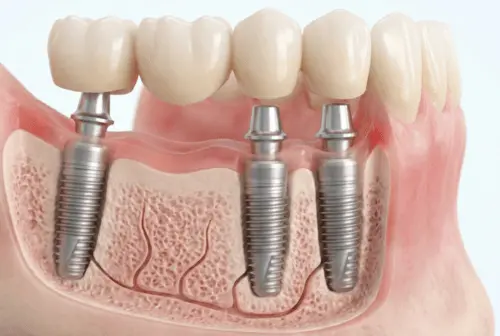
Multiple tooth implants are used to replace several missing teeth using a series of dental implants and a custom dental bridge.

Instead of placing an implant for every missing tooth, implants are strategically positioned in the jawbone to support multiple teeth.

This approach allows for:

  • fewer implants

  • strong support

  • natural appearance

  • long-term durability

Patients who are missing all teeth in an arch may also consider Full Arch Dental Implants or implant-supported dentures.

Why Replace Multiple Missing Teeth?

Missing multiple teeth can lead to several oral health issues if left untreated.

Jawbone Loss

When teeth are missing, the jawbone begins to deteriorate due to lack of stimulation.

Procedures such as Bone Grafting for Dental Implants may be required if bone loss has already occurred.

Shifting Teeth

Remaining teeth may shift into empty spaces, leading to bite problems and misalignment.

Difficulty Chewing and Speaking

Missing teeth can make it harder to eat certain foods and speak clearly.

Changes in Facial Appearance

Bone loss and missing teeth can cause the face to appear sunken or aged.

Replacing missing teeth with implants helps preserve facial structure and oral health.

Multiple Tooth Implants vs Dental Bridge

Traditional dental bridges rely on adjacent teeth for support, which requires those teeth to be reshaped.

With implant-supported bridges:

  • Adjacent teeth are not affected
  • Implants provide independent support
  • Jawbone is preserved

Learn more about this comparison here:
Implant vs Bridge

Benefits of Multiple Tooth Implants

Multiple tooth implants provide several advantages over traditional tooth replacement options.

  • Preserve jawbone and prevent bone loss
  • Do not require altering adjacent teeth
  • Provide strong and stable support
  • Restore natural chewing ability
  • Improve appearance and confidence
  • Long-lasting and durable solution

Patients who currently wear Complete and Partial Dentures may upgrade to implant-supported solutions for better stability.

Who Is a Candidate for Multiple Tooth Implants?

You may be a candidate if you:

  • Are missing several teeth in a row
  • Have healthy gums
  • Have sufficient jawbone density
  • Want a fixed, long-term solution
  • Want to avoid traditional bridges or dentures

Patients with bone loss may still qualify with the help of bone grafting.

Multiple Tooth Implants vs Other Implant Options

There are several implant solutions depending on your needs.

Single Tooth Dental Implant

Best for replacing one missing tooth

Multiple Tooth Implants

Ideal for replacing several missing teeth

Implant Supported Dentures

Used when most or all teeth are missing

Full Arch Dental Implants

Restore an entire arch with fewer implants

Each treatment is customized based on your oral health and goals.

Caring for Multiple Tooth Implants

Maintaining your implants is similar to caring for natural teeth.

  • Brush twice daily
  • Floss regularly
  • Visit your dentist for checkups
  • Maintain good oral hygiene

Proper care helps ensure long-term success and durability.

ADDITIONAL FREQUENTLY ASKED QUESTIONS ABOUT ALL-ON-4 DENTAL IMPLANTS

How many implants are needed to replace multiple teeth?

Typically, two or more implants can support a bridge that replaces several teeth.

Are multiple tooth implants better than bridges?

Yes, implants preserve the jawbone and do not require altering healthy teeth.

How long do multiple tooth implants last?

With proper care, dental implants can last decades.

Is the procedure painful?

Most patients report minimal discomfort, and anesthesia is used during the procedure.

Is there a dentist near me in Marlton that offers Multiple Tooth Implants

Yes.  At our Marlton dental office we offer multiple tooth implants to patients from Marlton and the surrounding area.  Contact our office today to schedule an appointment.